Collagen Powder, Bone Broth or Cofactors: What Actually Feeds Collagen
Three things get recommended for collagen: a scoop of collagen powder, a pot of bone broth, or a supplement. They are usually presented as three answers to one question.
They are not. Two of them answer the same question, and the third answers a different one entirely — and that distinction is the whole point.
What collagen is made of
Collagen is roughly 30% of the protein in the human body, and its composition is unusual. About one amino acid in three is glycine, the smallest one there is. Proline accounts for around another tenth.
Two further residues, hydroxyproline and hydroxylysine, do not come from food at all. They are made after the chain is assembled: enzymes modify proline and lysine that are already in place. Only then can the triple helix stabilise. Later, another enzyme cross-links the finished fibres into a load-bearing network.
So building collagen needs two separate things:
Raw material — glycine, proline, lysine.
Working enzymes — which have absolute cofactor requirements.
Almost every collagen article on the internet is about the first. This one is about why the second is a different question.
Bone broth and collagen powder are the same answer
Gelatine is denatured collagen. Bone broth is a gelatine extract. Hydrolysed collagen powder is gelatine broken down further into peptides. All three are the same material at different stages of processing.
Research has established that certain small peptides — proline-hydroxyproline among them — do appear in the bloodstream after collagen is eaten, which is the mechanism collagen supplements are built on. Gelatine-rich food delivers the same amino acid profile through the kitchen instead of the tub.
What ordinary protein does not do is substitute for this. A chicken breast or a scoop of whey is high in protein but low in glycine and contains no hydroxyproline. "Eat more protein" and "eat more gelatine" are not the same advice.
One more thing worth knowing, and it applies to every collagen product sold in Europe including the ones with the largest advertising budgets:
There is no authorised EU health claim for collagen or collagen peptides. Not one. A product may state how much it contains. None may state what it does.
That is not our opinion. It is what the EU register says, and it says the same for everyone.
The cofactors are a different question — and no amount of protein answers it
Here is the part that gets skipped.
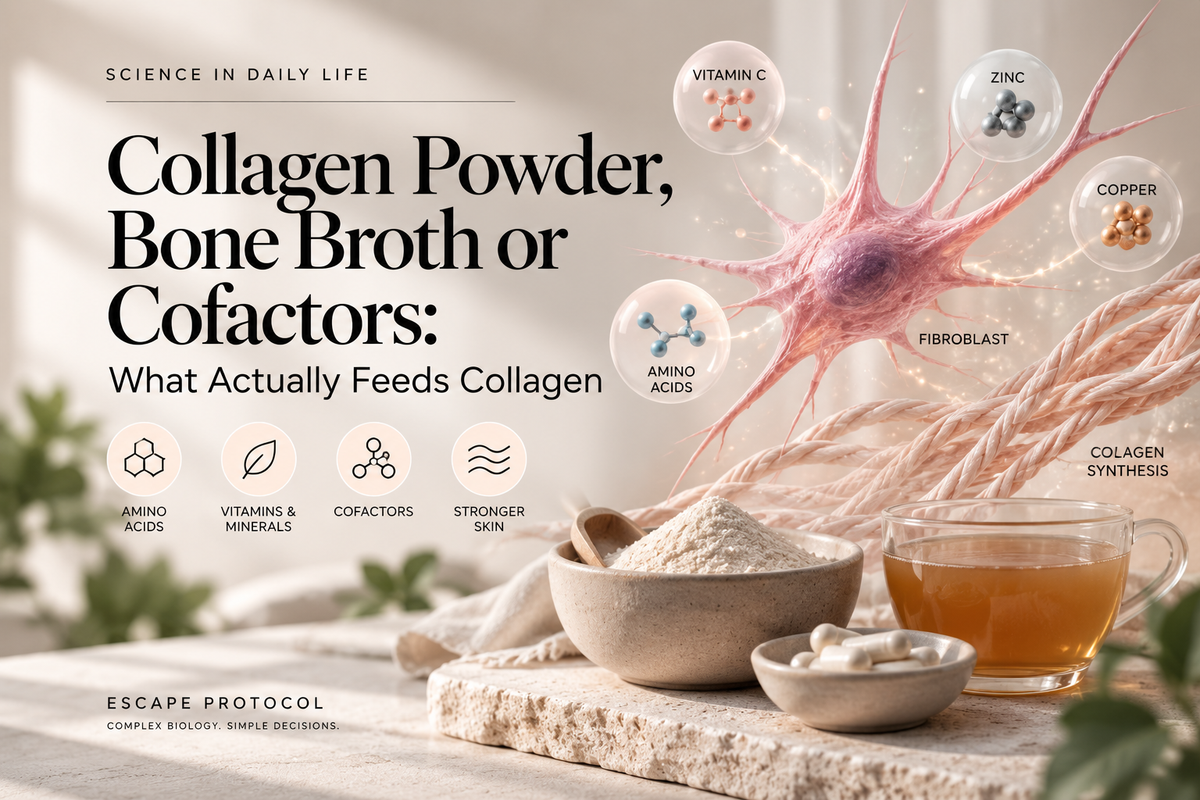
Vitamin C is required by prolyl and lysyl hydroxylase, the enzymes that perform the modification step described above. Without it, the chain cannot stabilise. Vitamin C contributes to normal collagen formation for the normal function of skin, bones and cartilage.*
Copper is required by lysyl oxidase, which cross-links collagen and elastin into a stable network. Copper contributes to the maintenance of normal connective tissue.*
Zinc contributes to normal protein synthesis and to the maintenance of normal skin, hair and nails.* Biotin contributes to the maintenance of normal skin and hair.*
Now look at where those come from. Vitamin C comes from peppers, citrus, berries, brassicas. Copper from shellfish, nuts, seeds, offal. Zinc from meat, shellfish, seeds. Biotin from eggs, liver, nuts.
None of them come from bone broth. None of them come from collagen powder. None of them come from eating more protein.
Bone broth contains essentially no vitamin C. Neither does a collagen scoop. So a person can do the raw-material side of collagen perfectly — daily broth, plenty of gelatine, ample protein — and the cofactor side remains exactly where it was, because it is fed by a completely different part of the diet.
This is the sentence worth keeping: more protein cannot answer a cofactor question. They are not on the same shelf, in the shop or in the body.
The three side by side
| What it supplies | Answers which question | Authorised EU claim | |
|---|---|---|---|
| Bone broth, gelatine | glycine, proline | raw material | — |
| Collagen powder | the same, pre-digested | raw material | none exists |
| Cofactor formula | vitamin C, copper, zinc, biotin | enzyme requirement | yes |
The first two are interchangeable. The third is not interchangeable with anything.
Skin Renewal Complex is the third column — fourteen active ingredients in two capsules a day: the four cofactors above, plus hyaluronic acid, MSM, coenzyme Q10, astaxanthin, L-glutathione, NAC, ceramides, choline, vitamin E and Polypodium leucotomos. There is no collagen in it, and no reason for there to be.
If you already take collagen peptides or drink broth, nothing here is in conflict. You have the raw material covered. This is the other half.
Collagen is not only skin
Collagen is structural, and it does the same job everywhere: cartilage, tendon, bone, blood vessel walls, gums, and the dermis under every surface of the body.
The lips make this visible. The red part has an unusually thin epidermis, almost no hair follicles and very few sebaceous glands — so what gives the lips shape and definition is not the surface at all, but the collagen and elastin matrix underneath. The skin around the mouth shows fine lines relatively early for the same structural reason: a thin dermis over constantly moving muscle.
This is anatomy, not a claim. No food supplement is presented here as changing the appearance of lips or anything else. What can be said is that the same cofactors are required for normal collagen formation throughout connective tissue — which is why vitamin C's authorised claim covers skin, bones and cartilage together.*
Frequently asked questions
Can I take collagen powder and Skin Renewal Complex together?
Yes. They answer different questions in the same chain.
Is bone broth as good as collagen powder?
They are the same material at different stages of processing. Powder is more convenient and more consistent in dose; broth is food.
Why doesn't Skin Renewal Complex contain collagen?
Because ingested collagen is broken down regardless, and the step we chose to support is the one with an established enzymatic requirement — and the only one that may be claimed in the EU.
Is food alone enough?
For the raw material, often yes, especially with regular gelatine-rich food. Whether the cofactor side is adequate is a separate question with a separate answer, and it depends on entirely different foods.
How long does connective tissue take to renew?
Months, not weeks. Nails grow about 3 mm a month, scalp hair about 1 cm, and the dermal collagen network is slower than both — which is why Skin Renewal Complex is offered as a 90-day supply.
Complex biology. Simple decisions.
*Authorised health claims under Regulation (EC) No 1924/2006. Food supplements are not a substitute for a varied and balanced diet and a healthy lifestyle. Do not exceed the recommended daily dose.