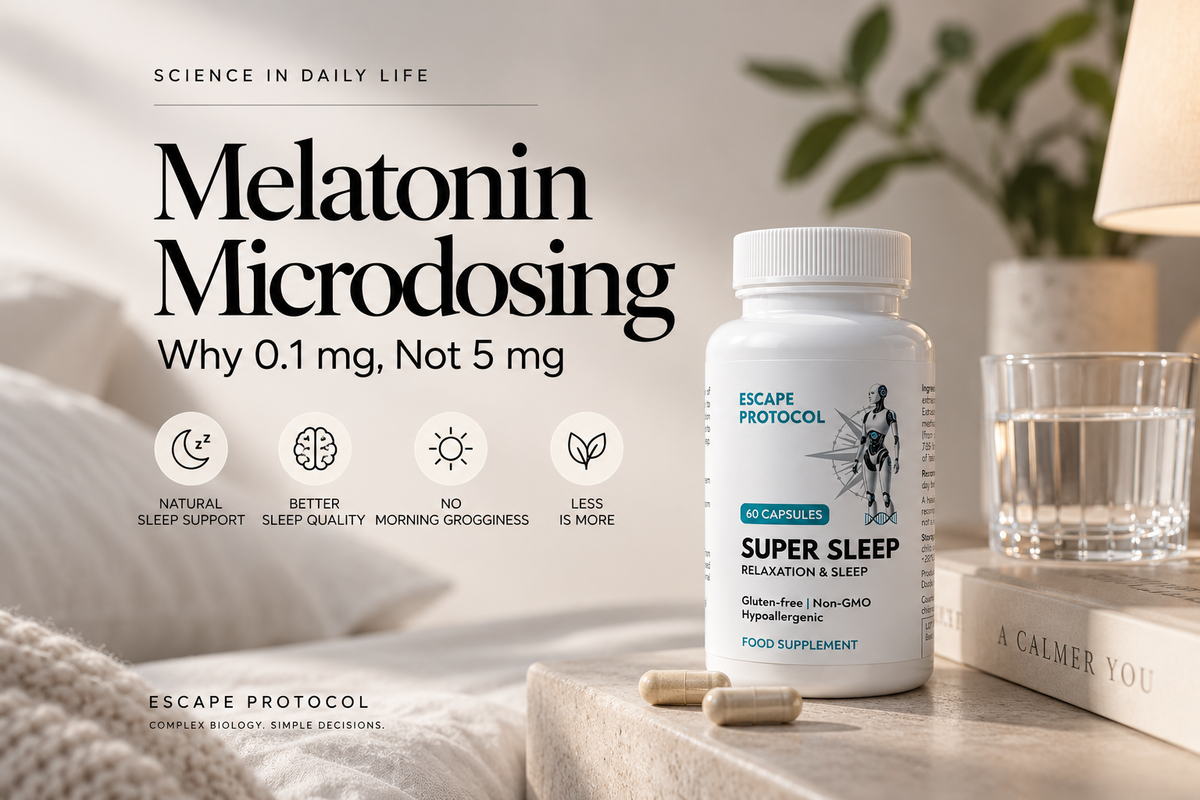
Melatonin Microdosing: Why 0.1 mg, Not 5 mg
Most melatonin supplements are sold in doses of 1, 3, 5 or even 10 mg. Escape Protocol Super Sleep contains 0.1 mg — one hundred micrograms.
That is not a rounding error, and it is not a cost decision. It is the entire design principle of the formula.
Melatonin is a time signal, not a sedative
Melatonin is often described as "the sleep hormone". Physiologically, it is more accurate to call it the hormone of darkness. The pineal gland begins releasing it when light input falls, and the rise in blood melatonin is the body's internal announcement that night has started.
It is a message, not a mechanism of sleep. The message tells the body's clocks what time it is.
One master clock, and a clock in every organ
The human circadian system is not a single timer. The master clock sits in the suprachiasmatic nucleus (SCN) of the hypothalamus, roughly 20,000 neurons above the optic chiasm, running on an intrinsic period of about 24 hours and 10–12 minutes. Because that period is not exactly 24 hours, it must be reset every single day by external time cues — Zeitgebers. Light is the strongest of them.
But almost every tissue in the body carries its own peripheral clock: liver, gut, skin fibroblasts, adipose tissue — and the heart.
Cardiomyocytes and vascular smooth muscle run autonomous circadian clocks. Heart rate, blood pressure, vascular tone and heart rate variability all follow a 24-hour rhythm, and the well-documented morning clustering of cardiovascular events is one of the more visible consequences of that rhythm in clinical medicine. This is, in plain terms, how a cardiologist ends up working in chronobiology. (Context on human physiology — not a claim about any product.)
The point that matters for supplementation is this: the SCN is entrained mainly by light, while peripheral clocks are also entrained by feeding time, activity and temperature. They can drift apart from each other. And melatonin, released at night and reaching every tissue, is one of the signals that keeps the periphery aligned with the centre.
Physiological versus pharmacological
Here is the number that decides everything.
In a healthy adult, plasma melatonin during the day sits below roughly 10 pg/mL. At night it rises into a range of about 30–120 pg/mL, with the onset of secretion — dim light melatonin onset, or DLMO — beginning roughly two hours before habitual bedtime.
That is the physiological signal. Picograms per millilitre.
An oral dose of 3–5 mg produces plasma concentrations reported in the tens of thousands of pg/mL — on the order of ten to a hundred times higher than the body's own nocturnal peak, and with a tail that can still be elevated the next morning. Doses in the range of 0.1–0.3 mg, by contrast, produce concentrations much closer to the natural night-time range.
A 5 mg dose does not send a stronger version of the same message. It sends a different kind of message — a pharmacological one, at a level the SCN never encounters in nature, and often at a time of day the body would read as still being night.
Escape Protocol chose the physiological end of that scale.
What this means legally — and we will say it plainly
Under EU Regulation (EC) No 1924/2006, the authorised health claim that melatonin contributes to a reduction of the time taken to fall asleep may only be used for a product containing at least 1 mg of melatonin per portion. The jet lag claim requires at least 0.5 mg.
Super Sleep contains 0.1 mg. We therefore make no health claim for melatonin at all. The microdose is included as a chronobiological time signal, not as a sleep agent, and we would rather explain that honestly than raise the dose in order to qualify for a sentence on the label.
What is in Super Sleep
Per capsule:
| Ingredient | Per capsule |
|---|---|
| L-glycine | 170 mg |
| Chamomile extract 4:1 (1.2% apigenin) | 150 mg |
| Ashwagandha KSM-66® | 120 mg |
| L-tryptophan | 73.5 mg |
| L-theanine (from green tea) | 30 mg |
| Magnesium (as bisglycinate) | 20 mg |
| Vitamin B6 (pyridoxine HCl) | 1.5 mg |
| Melatonin | 0.1 mg (100 µg) |
Vitamin B6 contributes to normal psychological function, to normal functioning of the nervous system and to the reduction of tiredness and fatigue.*
Note what the formula does not do: it does not stack sedating doses on top of one another. The melatonin is physiological, and the rest of the formula is built around amino acids that occur in ordinary food.
Why Super Sleep is not a magnesium product
Super Sleep contains 20 mg of magnesium per capsule. That is a functional amount inside the formula — magnesium bisglycinate is there as the carrier form for the glycine as much as for the mineral — but it is nowhere near a magnesium dose.
We say this openly because the alternative is to let the label imply otherwise. If you want magnesium in the evening, Super Sleep is not the product that delivers it.
Magnesium PM is. It provides 250 mg of elemental magnesium — 67% of the EU Nutrient Reference Value — from five magnesium forms: bisglycinate, taurate, citrate, lactate and gluconate. No magnesium oxide.
Magnesium contributes to normal functioning of the nervous system, normal muscle function, normal psychological function, electrolyte balance and the reduction of tiredness and fatigue.*
The Sleep Duo: two formulas, one evening
Put the two together and the division of labour is clean:
Magnesium PM supplies the mineral load — 250 mg of elemental magnesium across five forms, in the evening.
Super Sleep supplies the time signal and the amino acid profile — 0.1 mg of melatonin as a physiological darkness cue, with glycine, tryptophan, theanine, apigenin-standardised chamomile and KSM-66 ashwagandha.
Neither is a version of the other. Taken together as the Sleep Duo, the evening becomes a sequence rather than a single pill: magnesium and the darkness signal, at the hour the body is already preparing for.
This is the same principle that runs through the whole Escape Protocol system. Magnesium AM in the morning, Skin Renewal Complex in the middle of the day, Magnesium PM and Super Sleep at night. Time is an ingredient.
Frequently asked questions
Is 0.1 mg of melatonin too little to do anything?
It is a physiological dose rather than a pharmacological one — designed to sit within the concentration range the body itself produces at night, rather than far above it. Because it is below the 1 mg EU threshold, we make no health claim for it.
Why do most melatonin products contain 1–5 mg?
Partly because the authorised EU sleep claim requires at least 1 mg per portion, and partly because higher doses became the industry norm in markets where melatonin is sold over the counter without that threshold.
Can I take Super Sleep and Magnesium PM together?
Yes — that is the Sleep Duo, and it is how the two formulas were designed to be used. Super Sleep does not supply a meaningful magnesium dose on its own.
When should I take them?
In the evening, as part of a consistent routine. Consistency of timing is the point of a chronobiological approach; an irregular time cue is a weak time cue.
Does Super Sleep make you drowsy the next morning?
The formula was built at the physiological end of the melatonin range specifically to avoid the extended supraphysiological tail associated with multi-milligram doses.
Is melatonin a medicine?
That depends on dose and jurisdiction. At 0.1 mg per capsule, Super Sleep is a food supplement.
Complex biology. Simple decisions.
Escape Protocol formulas were developed by Dr Silvia Samarin, physician and scientist, founder of Escape Protocol.
*Authorised health claims under Regulation (EC) No 1924/2006. Food supplements are not a substitute for a varied and balanced diet and a healthy lifestyle. Do not exceed the recommended daily dose. Not recommended during pregnancy, breastfeeding, or for children and adolescents.