Article: How Long Does Collagen Actually Take?
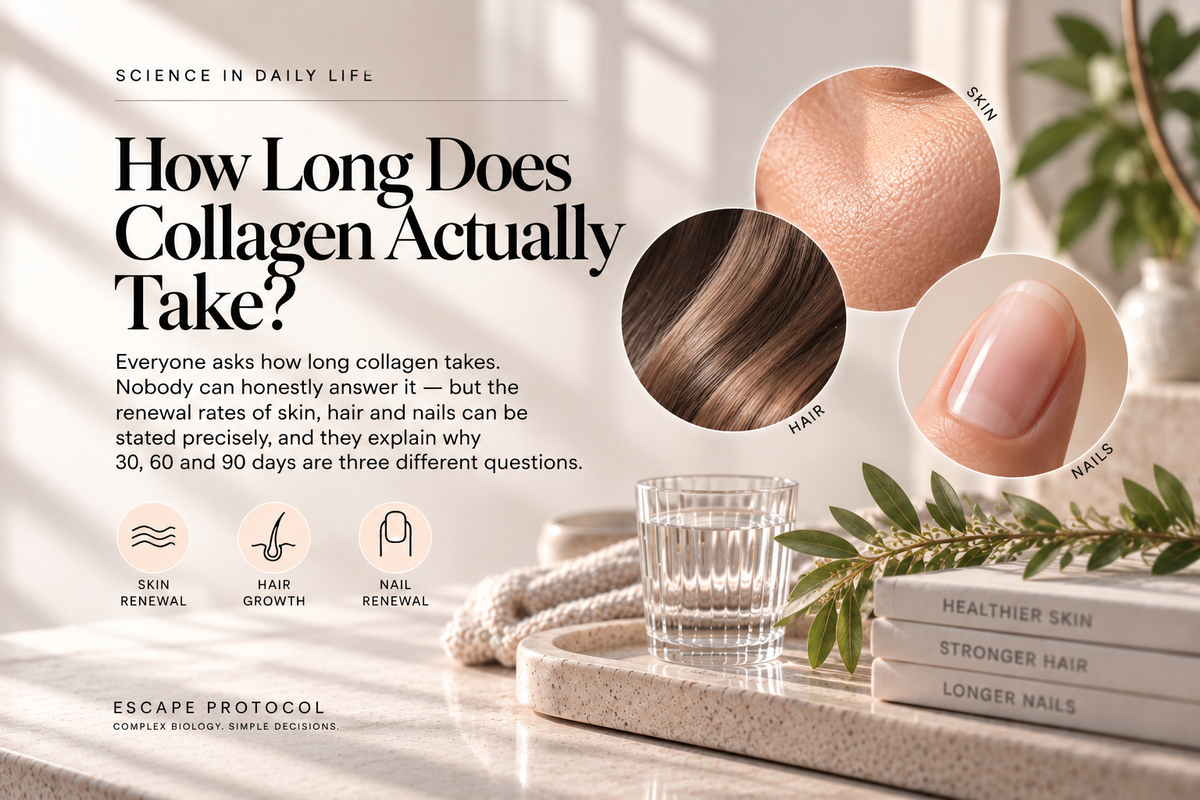
How Long Does Collagen Actually Take?
How Long Does New Collagen Actually Take to Form?
One of the most common questions about collagen is also one of the hardest.
The difficulty is that skin, hair and nails do not renew at the same speed. The epidermis turns over in weeks. Hair and nails grow across months. The collagen network in the dermis moves far more slowly than either.
So instead of promising results at 30, 60 or 90 days, let us look at what actually happens in each tissue over that time.
Why nobody can honestly give you a number of weeks
There are two reasons.
The first is legal, and it applies to every collagen product in Europe: no health claim has been authorised in the EU for collagen or collagen peptides. No product may say what collagen does — let alone when. Anyone quoting a timeline is promising something they are not permitted to claim.
The second is biological. Skin, hair and nails are not one tissue with one speed. They are several tissues, each renewing in its own way. One number cannot cover them.
What we can state precisely is this.
How fast each tissue renews
These are not claims about a product. This is biology.
Epidermis. Keratinocytes travel from the basal layer to the surface in 28 to 40 days, more slowly with age. One month is roughly one turnover of the outermost layer of skin.
Nails. The nail plate grows about 3 mm a month. A fingernail measures 12 to 15 mm from cuticle to free edge, so a nail formed in the matrix today needs four to six months to reach the tip. Toenails grow three times more slowly — a year to eighteen months.
Hair. Scalp hair grows about 1 cm a month. Each follicle stays in its growth phase for two to seven years, and 85 to 90 per cent of them are in that phase at any moment. Within a season you see new length at the root, not new hair.
Dermis. The collagen network beneath the skin renews the most slowly of all. Estimates run to years, some to more than a decade. In a month, nothing here changes.
What happens in 30, 60 and 90 days
This is not a promise. It is arithmetic.
At 30 days the epidermis has turned over once. The nail has grown about 3 mm, hair about 1 cm. In the dermis nothing has changed — and nothing could have.
At 60 days the new nail growth is a visible band, about 6 mm from the cuticle. Hair has grown about 2 cm. The epidermis has turned over a second time.
At 90 days a fingernail is half replaced and hair has grown about 3 cm. Only here do changes become something you can see rather than infer.
The dermis is still at the beginning even then. It always is.
This is why Skin Renewal Complex is sold as a 90-day supply. Not because something happens at three months, but because before then even the faster tissues have not grown enough to be worth looking at. A monthly box runs out before a nail is half replaced.
What slows renewal down
A capsule offsets none of this.
Age slows epidermal turnover and nail growth. Ultraviolet light breaks collagen down in the dermis faster than the body replaces it. Smoking does the same. At very low protein intake, the raw material itself is short. And in perimenopause the hormonal signal to dermal fibroblasts weakens — which is why skin changes often accelerate in the late thirties and forties.
A supplement covers one of these factors. Not the others. No honest page should suggest otherwise.
How to actually watch for it
Most people judge by memory, the least reliable measure there is. Two things are more reliable.
The nail band. Look at where new nail emerges at the cuticle. If anything is changing, it shows there first — and you can measure it with an ordinary ruler.
A photograph. Once a month. Same room, same hour, same distance, no makeup, daylight from the same side. The photograph itself is not the point. The point is that it takes memory out of the comparison.
Both take under a minute. Both beat an impression.
What is in Skin Renewal Complex
Fourteen active ingredients in two capsules a day: vitamin C, copper, zinc and biotin as the collagen cofactors, alongside hyaluronic acid, MSM, L-glutathione, N-acetyl-cysteine, coenzyme Q10, astaxanthin, ceramides, choline, vitamin E and Polypodium leucotomos.
Vitamin C contributes to normal collagen formation for the normal function of skin, bones and cartilage. Copper contributes to the maintenance of normal connective tissue. Zinc contributes to the maintenance of normal skin, hair and nails. Biotin contributes to the maintenance of normal skin and hair. Vitamin C, vitamin E, zinc and copper contribute to the protection of cells from oxidative stress.*
Those are the sentences we are permitted to write. Everything else is arithmetic and patience.
Frequently asked questions
So when will I see something?
That is exactly what nobody can answer for you — which is why this page offers renewal rates instead. All we can say is this: before three months, the faster tissues have not grown enough for anything to be noticed.
Is one month worth it?
For the arithmetic above, a month is short. Nails and hair renew across months, the dermis across years.
Does it show sooner in younger people?
The epidermis turns over faster in younger people, and nails grow faster too. That is tissue biology, not a product effect.
Should I take it alongside collagen powder?
They act at different points. Powder brings the raw material, the cofactors bring what the enzymes need during synthesis.
Why do nails show it first?
Because new nail emerges as a visible band at the cuticle and can be measured. Hair grows the same way but from many follicles at once. The dermis gives no visible signal at all.
Complex biology. Simple decisions.
*Authorised health claims under Regulation (EC) No 1924/2006. Food supplements are not a substitute for a varied and balanced diet and a healthy lifestyle. Do not exceed the recommended daily dose.